
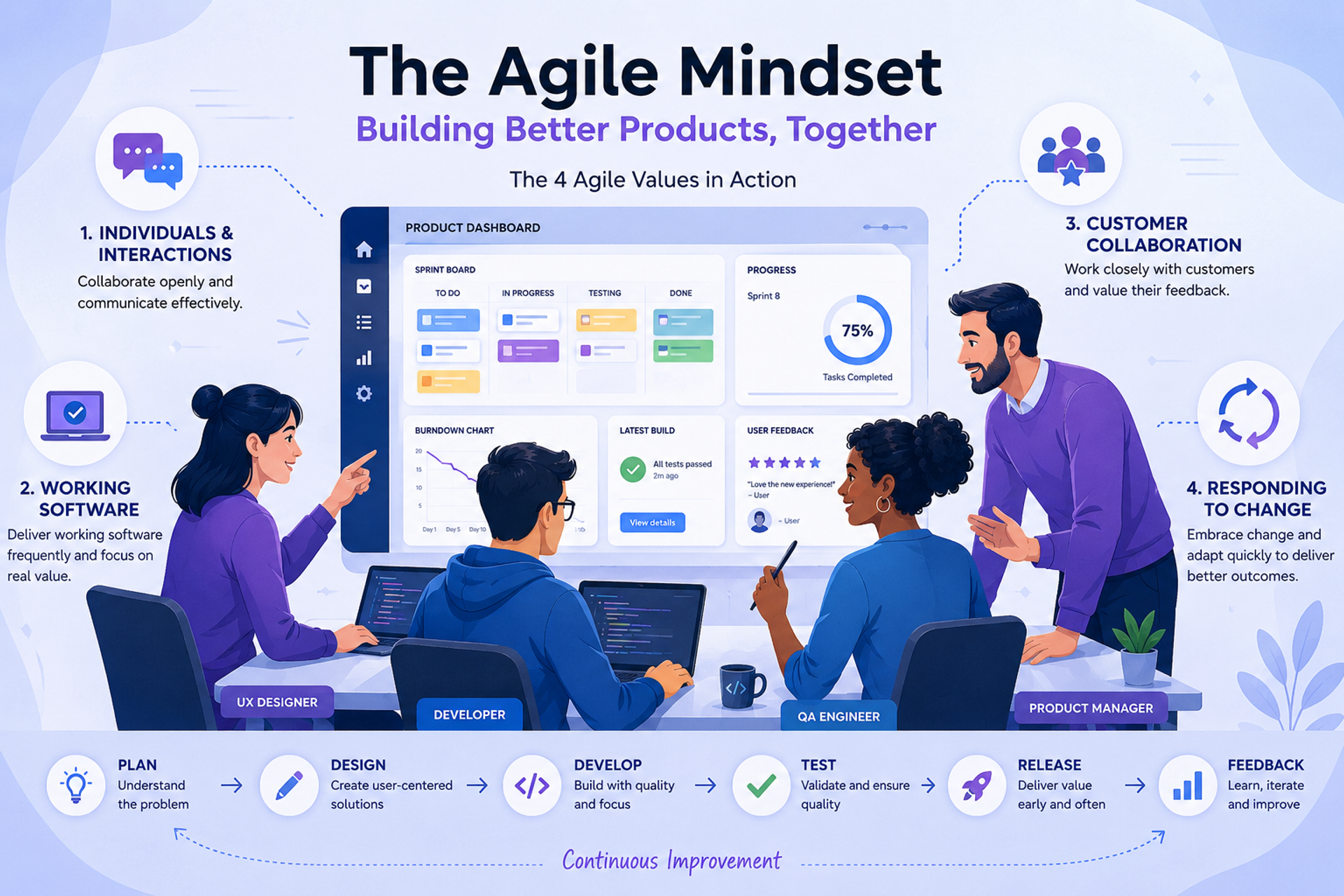

Beyond Scrum: The Mindset Behind the Agile Manifesto
When people hear the word Agile, they often think of sprint planning, daily stand-ups, Jira tickets, or retrospectives. While these practices are important, they are only a small part of what Agile truly represents.
At its core, Agile is a mindset centered around delivering value quickly, adapting to change, and keeping users at the heart of product development.
What is Agile?
The word agile means the ability to move quickly and easily. In software development, Agile refers to an approach that helps teams deliver value faster, respond effectively to changing requirements, and continuously improve their products.
In 2001, a group of software professionals came together to address the limitations of traditional development approaches, which often involved lengthy planning, extensive documentation, and delayed feedback. Their discussions resulted in the Agile Manifesto, a document that introduced four core values and twelve guiding principles that continue to influence modern product development today.
The Four Values of the Agile Manifesto
The Agile Manifesto does not say that processes, documentation, contracts, or planning are unimportant. Instead, it tells us what should be prioritized when making decisions.
1. Individuals and Interactions Over Processes and Tools
Successful products are built by people, not by tools.
While processes and tools help teams stay organized, collaboration and communication often have a greater impact on outcomes.
For example, when a tester discovers a defect, a quick discussion with the developer can sometimes resolve the issue faster than immediately creating multiple tickets and following a lengthy workflow.
Tools should support collaboration, not replace it.
2. Working Software Over Comprehensive Documentation
Documentation is important, but it does not create value on its own.
A team may spend weeks writing detailed requirements, yet still discover misunderstandings once development begins. On the other hand, a working prototype or MVP can provide immediate feedback and reveal opportunities for improvement.
A functioning feature is often more valuable than pages of documentation describing how it should work.
3. Customer Collaboration Over Contract Negotiation
The best products are built with customers, not simply for them.
Customer needs evolve as they interact with a product and gain a better understanding of what solves their problems. Agile encourages teams to gather feedback regularly rather than relying solely on initial requirements.
By collaborating continuously with customers, teams can ensure they are building solutions that truly meet user needs.
4. Responding to Change Over Following a Plan
Plans are useful, but change is inevitable.
Market conditions shift, competitors introduce new features, and customer expectations evolve. Agile teams recognize that adapting to these changes is often more valuable than rigidly following a plan created months earlier.
The ability to respond quickly to change helps organizations remain competitive and relevant.
The Twelve Principles Behind Agile
The four values establish Agile's foundation, while the twelve principles provide practical guidance for applying those values in everyday work.
1. Satisfy the Customer Through Early and Continuous Delivery
The highest priority is to deliver valuable software early and continuously.
This is why Agile projects are often divided into short iterations or sprints. Each sprint delivers something useful to users, creating opportunities for feedback and improvement.
2. Welcome Changing Requirements, Even Late in Development
Agile views change as an opportunity rather than a disruption.
A new customer need, market trend, or business opportunity may emerge during development. Instead of resisting change, Agile teams adapt and use it to create greater value.
3. Deliver Working Software Frequently
Rather than waiting months for a major release, Agile teams aim to deliver working software regularly.
Frequent releases reduce risk, increase visibility, and allow teams to learn from real user feedback sooner.
4. Business People and Developers Must Work Together Daily
Strong collaboration between business stakeholders and development teams ensures everyone remains aligned on goals, priorities, and customer needs.
Regular communication reduces misunderstandings and enables faster decision-making.
5. Build Projects Around Motivated Individuals
People perform best when they are trusted, supported, and empowered.
Agile teams thrive when members have the resources they need and the autonomy to make decisions about their work.
6. Face-to-Face Conversation Is the Most Effective Form of Communication
The Agile Manifesto emphasizes direct communication because it reduces misunderstandings and speeds up problem-solving.
While many modern teams work remotely, video calls, collaborative discussions, and real-time communication help achieve the same objective.
7. Working Software Is the Primary Measure of Progress
Progress is not measured by the number of meetings held, documents created, or tasks completed.
The true measure of progress is software that works and delivers value to users.
8. Agile Processes Promote Sustainable Development
High-performing teams are not built through constant overtime or burnout.
Agile promotes a sustainable pace that allows teams to maintain productivity and quality over the long term.
9. Continuous Attention to Technical Excellence and Good Design Enhances Agility
Moving quickly should never come at the expense of quality.
Strong engineering practices, thoughtful design, and continuous improvement make it easier to adapt to future changes without introducing unnecessary complexity.
10. Simplicity Is Essential
Agile encourages teams to focus on work that creates value.
Features, processes, or activities that do not contribute meaningfully to customer or business outcomes should be questioned and, when appropriate, eliminated.
11. The Best Solutions Emerge From Self-Organizing Teams
The people closest to the work often have the best understanding of how to solve problems effectively.
Agile teams are trusted to organize their work, collaborate, and make decisions without excessive micromanagement.
12. Regular Reflection Leads to Continuous Improvement
At regular intervals, Agile teams evaluate their performance and identify opportunities for improvement.
Sprint retrospectives are a common example, where teams discuss what went well, what could be improved, and how they can work more effectively moving forward.
Why Agile Still Matters
More than two decades after its creation, the Agile Manifesto remains highly relevant.
Whether as a developer, tester, designer, product manager, or business stakeholder, Agile encourages collaboration, adaptability, and a relentless focus on delivering value.
Agile is not about working faster for the sake of speed. It is about building the right products, learning from feedback, embracing change, and continuously improving how team work together.
When viewed as a mindset rather than a process, Agile becomes more than a methodology, it becomes a way of creating better products and stronger teams.