


One Brain or Many? Choosing Between Single-Agent and Multi-Agent Systems
AI agents are becoming part of almost every new product conversation.
Build an agent for customer support. Build an agent for engineering. Build agents for research. Build a team of agents that talk to each other.
And somewhere along the way, it became easy to assume that more agents means a smarter system.
It doesn't.
A multi-agent system can be powerful, but it can also be an unnecessarily complicated way to solve a problem that one capable agent could handle perfectly well.
The better question is not:
How many agents should we build?
It's:
What can one agent not do that requires us to introduce another?
That distinction matters.
What do we mean by an agent?
An agent is more than a chatbot that receives a question and generates a response.
An agent can work towards a goal, decide what information it needs, use tools, observe the results, and decide what to do next.
Imagine asking an engineering assistant:
Why is the payment API failing in production?
A useful agent might:
- Check the production logs.
- Identify the error.
- Look at the most recent deployment.
- Check what changed in the deployed commit.
- Inspect the relevant code.
- Put the evidence together and explain the likely cause.
The important thing here is that the agent does not need to know the answer before it starts.
It can investigate.
One agent does not mean one capability
This is one of the biggest misconceptions when designing agent systems.
A single agent can have access to many tools.
For an engineering agent, those tools might include:
- GitHub or GitLab
- Production logs
- Deployment history
- Databases
- APIs
- Documentation
- Metrics and monitoring
Having multiple sources of information does not automatically mean you need multiple agents.
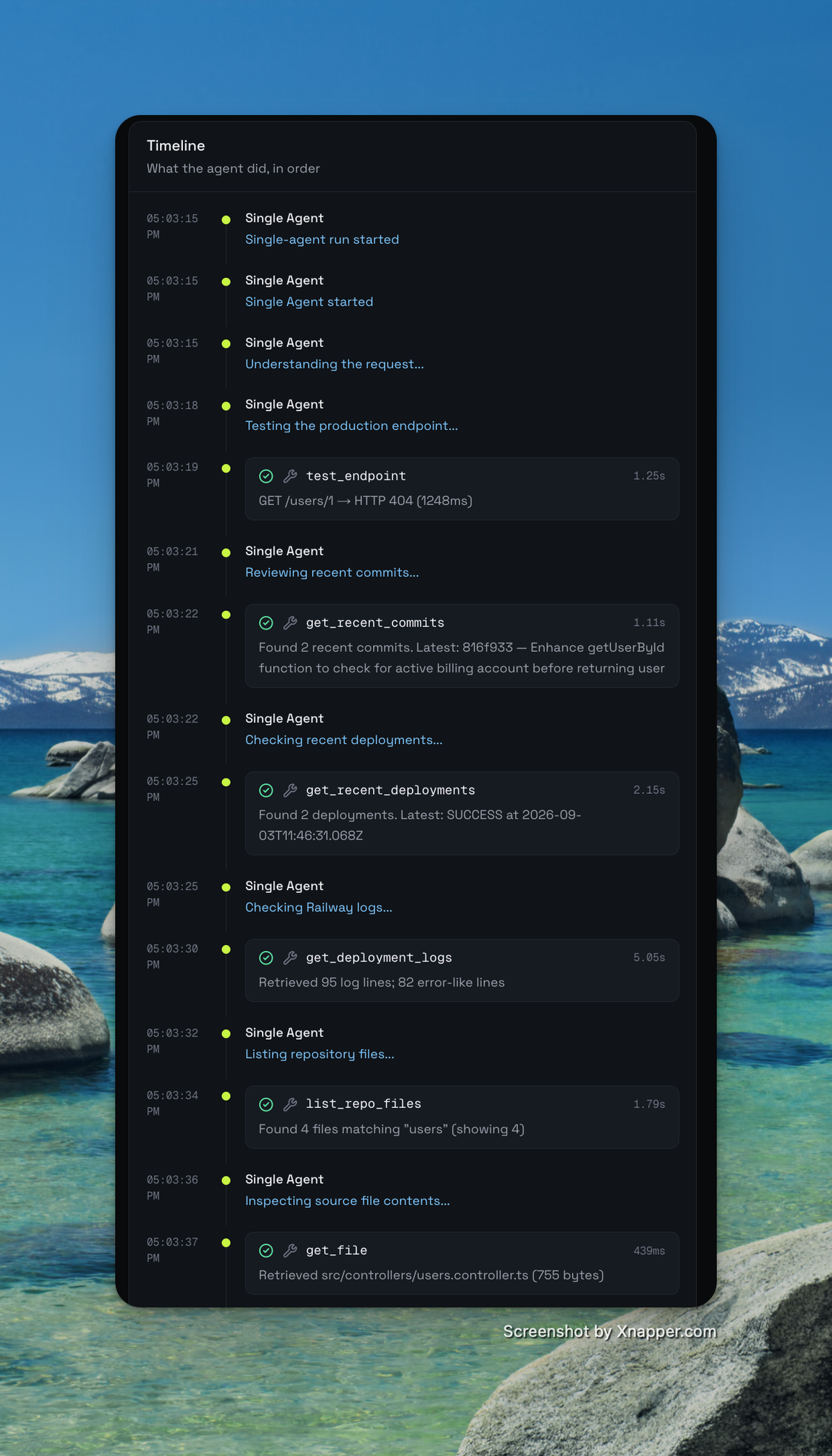
Consider a production debugging scenario.
A single agent could receive this task:
The /users/:id API is returning 500 errors in production. Find out why.The agent could then use its tools to:
- Search the logs.
- Find the failing request.
- Check the latest deployment.
- Inspect the deployed commit.
- Search for the relevant code.
- Compare recent changes.
That is still one agent.
It simply has multiple tools available to it.
The same idea applies to customer support.
Suppose a customer asks:
Why hasn't my loan application been approved?
One agent could check:
- The customer's application.
- Their current application status.
- The credit decision.
- Missing requirements.
- Previous communication.
You don't automatically need a Customer Agent, Loan Agent, Credit Agent, and Communication Agent.
Sometimes one agent with the right tools and context is enough.
When is a single agent enough?
In many cases, starting with a single agent is the best option.
The task is straightforward
If the agent can understand the problem, use a few tools, and produce an answer, adding more agents may not provide much value.
For example:
Find all failed transactions from yesterday.
The agent can query the data and return the result.
There is little reason to introduce a planner, researcher, analyst, and executor for a task like this.
The work is mostly sequential
Some tasks naturally follow a sequence.
For example:
- Check the logs.
- Find the error.
- Inspect the related code.
- Explain the issue.
A single agent can move through these steps while keeping the full context of what it has discovered.
Shared context matters
Every time information moves from one agent to another, something can be lost.
One agent may discover an important detail and summarize it before passing it to another agent. The next agent may interpret that summary differently.
Keeping the investigation within one agent can sometimes produce better results simply because the entire context stays together.
Tools already provide specialization
This is worth repeating.
A database query tool is already specialized.
A GitHub search tool is already specialized.
A logs tool is already specialized.
You do not necessarily need an AI agent in front of every tool.
When do multiple agents actually make sense?
Multi-agent systems are not bad. They are useful when there is a clear reason to split the work.
Parallel work
This is one of the strongest reasons to use multiple agents.
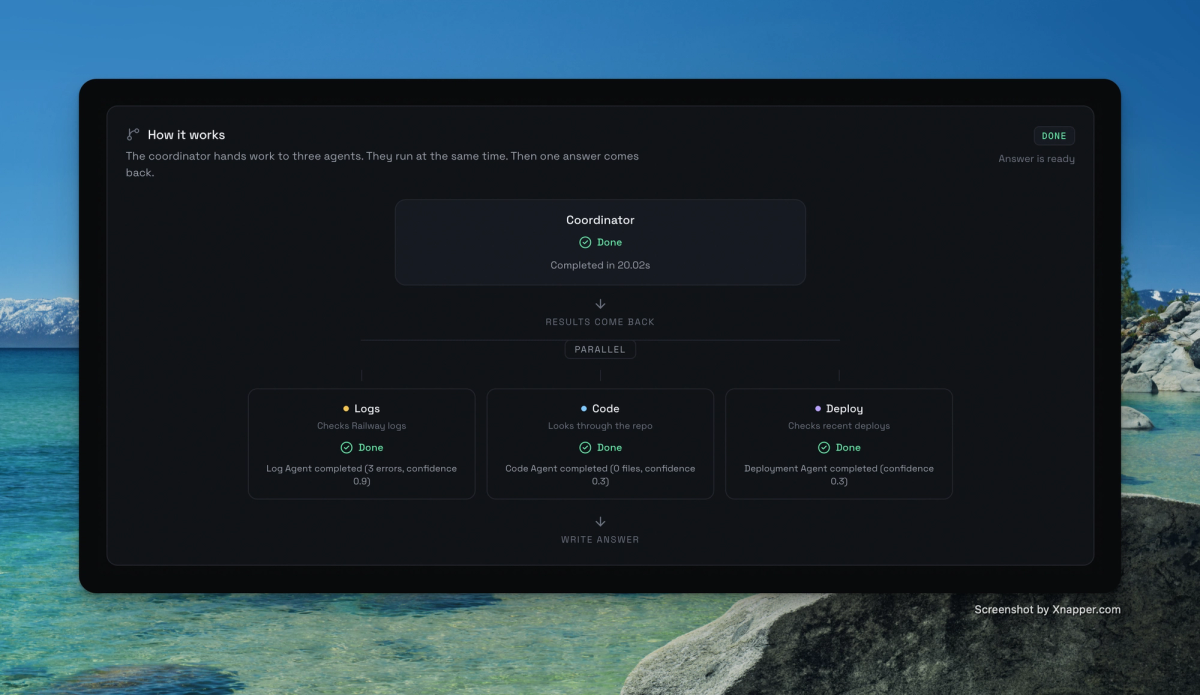
Imagine a production incident where you need to investigate:
- Production logs.
- Recent deployments.
- Recent code changes.
If these investigations can happen independently, multiple agents can work on them at the same time.
For example:
- Agent 1 investigates the logs.
- Agent 2 checks deployment history.
- Agent 3 analyzes recent commits.
A coordinator can then combine the results.
In this situation, multiple agents may reduce the total investigation time.
Different areas of expertise
Some tasks genuinely benefit from different perspectives.
Consider a security review.
One agent could focus on authentication and authorization.
Another could examine database access.
Another could review infrastructure configuration.
The value here is not simply having more agents. The value comes from giving each agent a clear responsibility and evaluation criteria.
Different permissions
This is an interesting use case that is easy to overlook.
Not every agent should have the same access.
Imagine an AI system helping engineers investigate production incidents.
A Logs Agent might have read-only access to production logs.
A Deployment Agent might be able to inspect deployments.
A Database Agent might be restricted to read-only queries.
A separate Action Agent might be allowed to restart a service, but only after human approval.
Splitting responsibilities this way can make permission boundaries easier to manage.
Independent tasks
Before creating multiple agents, ask:
Can these tasks actually happen independently?
If Agent B cannot begin until Agent A finishes, splitting them might not provide much benefit.
You may simply be turning one agent into multiple agents that now have to wait for each other.
The popular Planner → Researcher → Executor pattern
A common multi-agent architecture looks like this:
- Planner Agent
- Researcher Agent
- Executor Agent
The planner breaks the task down.
The researcher gathers information.
The executor performs the action.
This can work well for complex workflows.
But it is important to ask whether each role actually needs to be a separate agent.
Suppose the task is:
Find all failed payments from yesterday.
Do we need:
- A Planner Agent to decide how to search?
- A Researcher Agent to run the query?
- An Executor Agent to return the results?
Probably not.
Sometimes a multi-agent architecture is simply a single workflow broken into several unnecessary components.
A single capable agent can plan, research, and execute as part of the same process.
The architecture should exist because it solves a problem, not because the diagram looks impressive.
The cost of adding agents
Every new agent introduces complexity.
More cost
More agents usually means more model calls.
More model calls mean more tokens.
More tokens mean more money.
More latency
If agents have to wait for each other, the system becomes slower.
The coordinator waits for the researcher.
The researcher waits for another agent.
That agent waits for more information.
Before long, the system has turned into an expensive chain of conversations.
More coordination
Someone needs to decide:
- Which agent handles what?
- How do agents communicate?
- What happens when one agent fails?
- How is conflicting information resolved?
- Who produces the final answer?
The more agents you add, the more orchestration logic you need.
Context loss
One of the biggest risks is information loss during handoffs.
Imagine the original evidence says:
The API started failing 10 minutes after deployment version 1.4.2.
Agent One summarizes it as:
The API started failing after a deployment.
Agent Two interprets it as:
The deployment may have caused the failure.
Agent Three eventually concludes:
The deployment caused the issue.
Notice what happened.
The original evidence did not prove that the deployment caused the issue. It only showed that the failure started shortly after the deployment.
Every handoff introduced interpretation.
This is one reason multi-agent communication needs to be designed carefully.
A simple decision framework
When deciding between a single agent and multiple agents, I would start with these questions.
1. Can one agent solve the problem with the available tools?
If yes, start with one agent.
Do not introduce additional complexity without a reason.
2. Can parts of the work happen independently?
If yes, multiple agents may provide value through parallel execution.
3. Do different parts require genuinely different expertise?
If yes, specialized agents may improve the quality of the work.
4. Are different permissions required?
If different parts of the system require different levels of access, separating responsibilities can improve security and control.
5. What specific problem does another agent solve?
This might be the most important question.
If you cannot clearly answer it, you probably do not need another agent.
A practical example: debugging a production API
Consider this problem:
The /users/usr_001 API is failing in production. Find out why.A single-agent approach
One agent investigates the issue.
It:
- Checks the logs.
- Finds the error.
- Checks the latest deployment.
- Looks at recent commits.
- Inspects the relevant files.
- Correlates the evidence.
- Produces a diagnosis.
This approach is simple.
The agent keeps the entire investigation in one context.
It may be slower than parallel execution, but it is easier to build, debug, and reason about.
A multi-agent approach
A coordinator receives the problem and delegates the investigation.
At the same time:
- The Logs Agent investigates production errors.
- The Deployment Agent checks recent deployments.
- The Code Agent analyzes recent changes.
The coordinator then combines the evidence.
This could be faster because independent tasks are happening in parallel.
But it comes with additional cost and complexity.
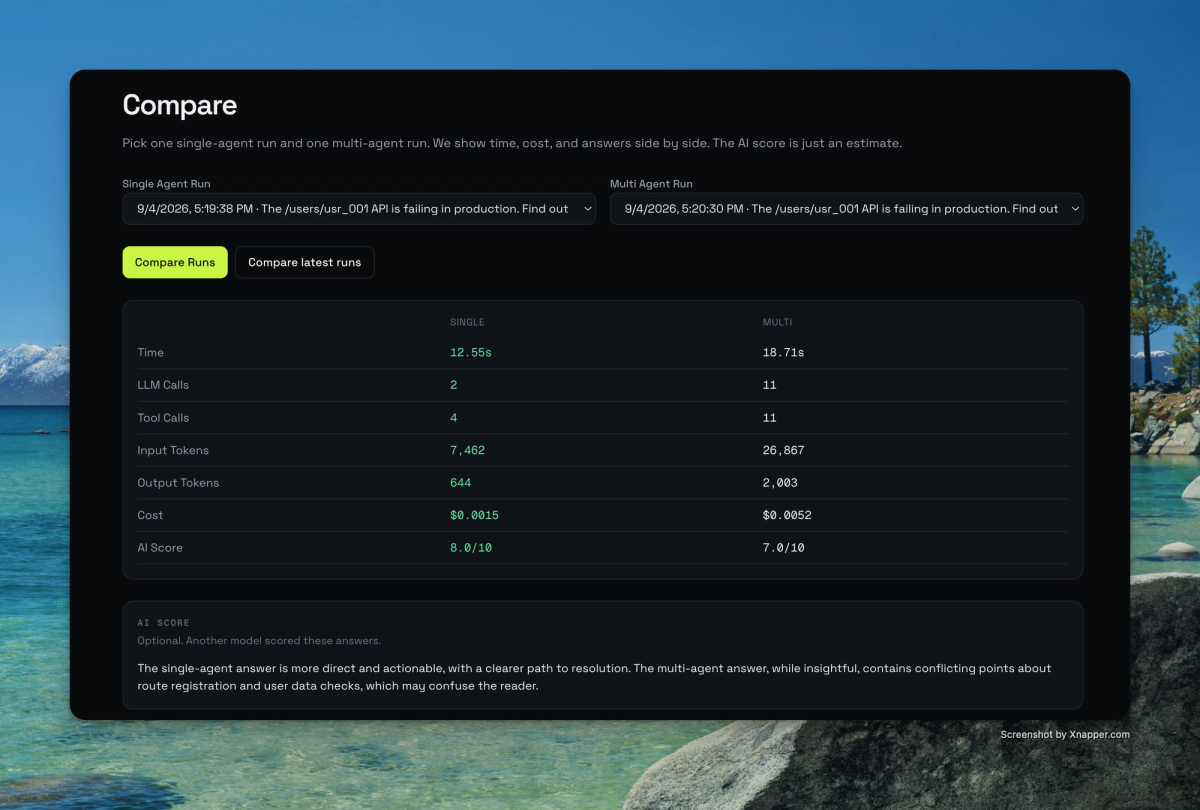
What happened when we compared them?
The interesting part is not simply whether one architecture won.
The interesting part is what we learn by measuring both.
For the same problem, we can compare:
- Investigation time
- Number of LLM calls
- Number of tool calls
- Token usage
- Estimated cost
- Result quality
This gives us something better than saying:
"Multi-agent feels faster."
We can actually look at the numbers.
Maybe the multi agent costs more.
Maybe the single agent gets the same answer with fewer calls.
Maybe one architecture produces a better diagnosis for a particular type of task.
The point is to measure the trade-off instead of assuming that one architecture is always better.
The same architecture can support more than debugging
An interesting thing about building agent systems is that the tools often matter more than the original use case.
An engineering agent with access to source code, logs, deployments, and documentation does not have to be limited to debugging.
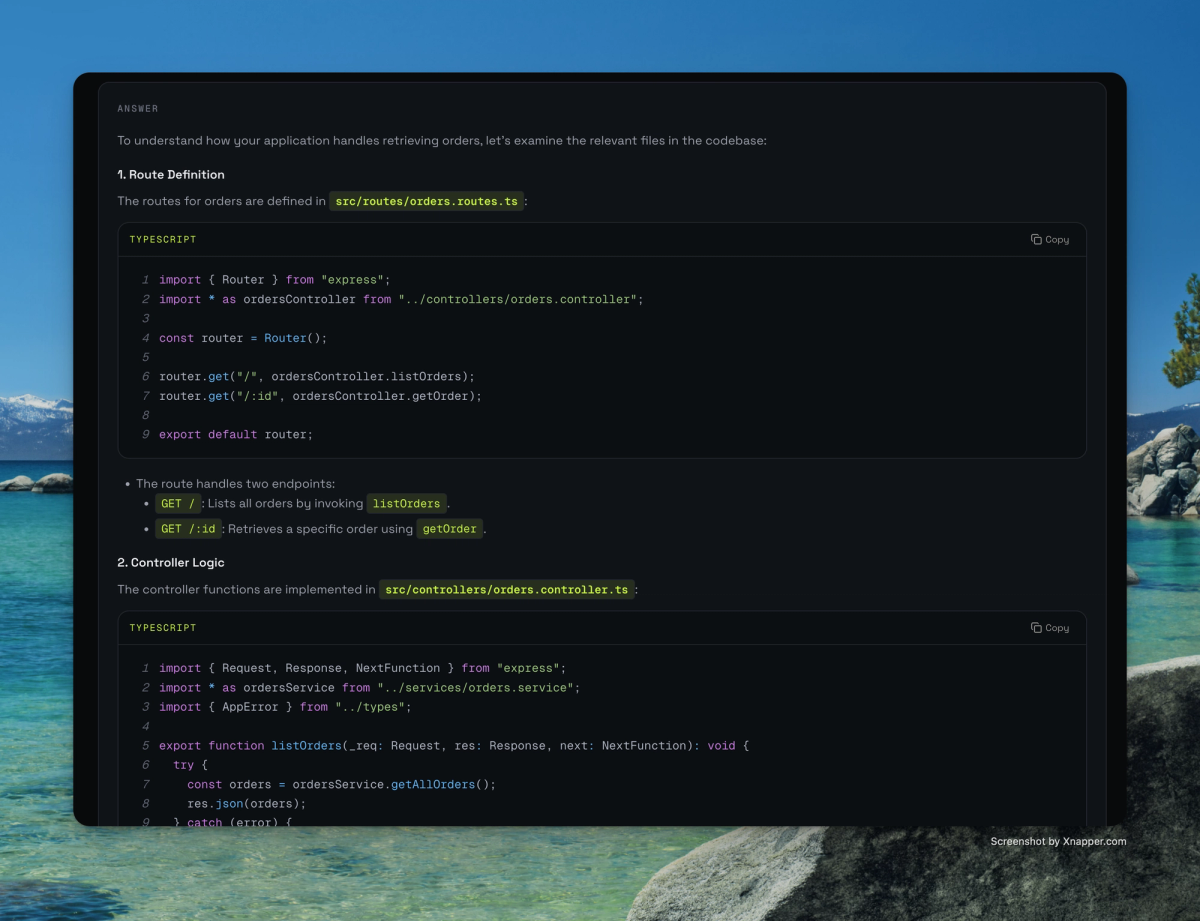
It could answer questions such as:
How does authentication work in this application?
It could search the repository, inspect middleware, find authentication routes, trace database calls, and explain the flow.
Or:
Where is the loan repayment calculation implemented?
It could locate the relevant files and functions and explain how the logic works.
Or:
Show me all production errors between 2 PM and 4 PM yesterday.
It could retrieve logs for the requested period, group similar errors, and summarize what happened.
The same agent architecture can support many engineering workflows because the agent is not defined only by its prompt.
It is defined by the tools and information it can access.
Start simple
The biggest lesson from all of this is simple:
Start with one agent.
Give it the tools it needs.
Test whether it can solve the problem reliably.
Measure the quality, latency, and cost.
Then ask:
What limitation are we experiencing?
Maybe the problem is latency.
Parallel agents might help.
Maybe the problem requires different areas of expertise.
Specialized agents might help.
Maybe different permissions are required.
Separate agents might provide better boundaries.
But complexity should be earned.
Do not build a multi-agent system because multi-agent systems are popular.
Build one when multiple agents solve a real limitation that a single agent cannot.
At the end of the day, the goal is not to build the most impressive architecture.
The goal is to solve the problem well.
Sometimes that requires one brain.
Sometimes it requires many.
The important part is knowing why.